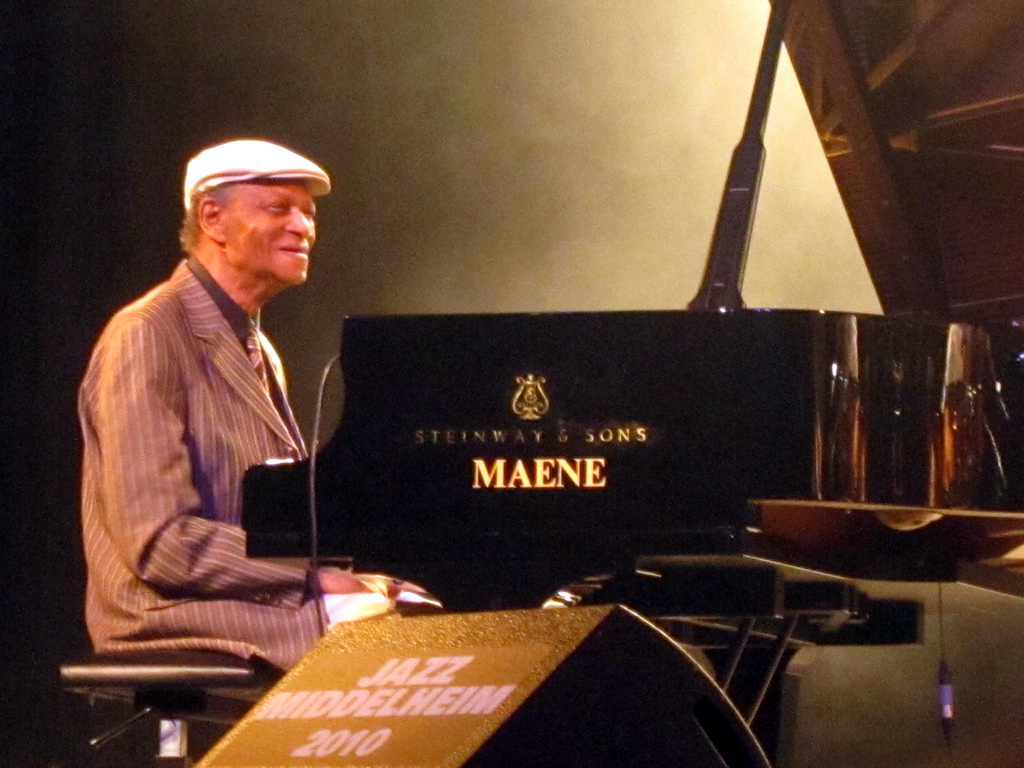
McCoy
Tyner: The Thunder and
the Light of Modern
Jazz Piano
McCoy Tyner was an
architectural giant of
modern jazz piano
Britannica. His thundering
left-hand fourth chords
and explosive pentatonic
runs redefined the
instrument. As the
harmonic anchor of the
John Coltrane Quartet,
Tyner fundamentally
altered the trajectory of
American music. His
massive chordal voicings
balanced raw power with
deep spirituality,
bridging bebop, modal
jazz, and avant-garde
expression. Over a career
spanning six decades, he
recorded dozens of albums
as a leader, mentored
generations of players,
and established a towering
sonic legacy Blue Note
Records.
Early
Life and the
Philadelphia
Foundation Alfred McCoy Tyner was
born in Philadelphia,
Pennsylvania, on December
11, 1938 Britannica. He
grew up in a vibrant,
culturally rich
neighborhood that served
as a fertile breeding
ground for mid-century
jazz talent. Encouraged by
his mother, a beautician
who installed a piano in
her shop, Tyner began
formal classical lessons
at age 13. However, the
sights and sounds of the
local jazz scene quickly
captured his imagination.
By his mid-teens, Tyner
was leading his own
ensemble, the Granz
Connors All Stars. The
Tyner household became a
neighborhood nexus where
local players gathered to
jam and debate music. His
peers and neighbors
included legendary
musicians like Lee
Morgan, Bobby
Timmons, and the Heath
brothers(Percy,
Albert, and Jimmy). This
immersion taught him the
value of community,
rhythmic discipline, and
creative fearlessness.
A pivotal moment occurred
during his teenage years
when he met Bud Powell,
the pioneer of bebop
piano. Powell lived around
the corner from the
Tyners. Studying Powell’s
lightning-fast linear
phrasing and aggressive
right-hand attacks
directly shaped Tyner's
early style. Around this
same time, at age 17,
Tyner embraced Islam,
adopting the name Sulaimon
Saud, though he
continued to perform under
his birth name. This
spiritual grounding
provided him with a
lifelong sense of inner
peace that balanced his
intense physical command
of the keyboard.
The
Call from John
Coltrane and the
Jazztet
In 1957, while gigging
around Philadelphia, Tyner
met saxophonist John
Coltrane at the Red
Rooster club. Coltrane,
who was playing with Miles
Davis, recognized a
kindred spirit in the
young pianist. Despite a
12-year age gap, the two
struck up a deep artistic
and personal brotherhood.
Coltrane promised Tyner
that once he formed his
own permanent group, Tyner
would be his pianist.
While waiting for
Coltrane's solo venture to
materialize, Tyner made
his major-league debut in
1959. He joined the Jazztet,
an influential hard-bop
sextet co-led by trumpeter
Art Farmer and
saxophonist Benny
Golson. Tyner made
his first appearance on a
commercial recording on
their landmark 1060 album,
Meet the Jazztet.
His playing on tracks like
"Killer Joe" demonstrated
a highly sophisticated
harmonic sense and a
crisp, swinging touch.
The
Legendary Classic
Quartet (1960–1965)
In 1960, Coltrane
officially called Tyner to
join his new ensemble. By
1962, with the addition of
bassist Jimmy Garrison
and explosive drummer Elvin
Jones, the John
Coltrane Quartet was
complete. This "Classic
Quartet" became one of the
most influential, tightly
knit groups in music
history.
Tyner’s role in the
quartet was both
liberating and grounding.
Coltrane’s music was
transitioning away from
traditional chord
progressions into modal
jazz, which used
musical scales rather than
rapid chord changes. Tyner
pioneered a revolutionary
technique to navigate this
open space: quartal
voicings. Instead of
stacking chords in
traditional thirds, he
stacked them in fourths.
This gave the music an
open, ambiguous sound,
allowing Coltrane total
freedom to solo without
being locked into a
specific key.
To balance the volcanic
polyrhythms of drummer
Elvin Jones, Tyner
developed a powerful,
percussive left-hand
technique. He frequently
struck heavy, ringing
low-register fifths and
octaves. This became
the rhythmic and harmonic
anchor of the band.
Meanwhile, his right hand
flew across the keys,
cascading in brilliant
pentatonic scales and
rapid-fire arpeggios.
Together, the group
recorded a string of
masterpieces for Impulse!
Records, including:
• My Favorite
Things (1961):
A reimagining of the
Broadway hit that
showcased Tyner's
hypnotic, trilling modal
accompaniment.
• Live at the
Village Vanguard (1962):
Capturing the band's raw,
extended improvisational
energy.
• Crescent
(1964): A deeply
reflective, lyrical album
highlighting Tyner's
poetic side.
• A Love Supreme
(1965): A four-part
spiritual suite
universally regarded as
one of the greatest albums
of all time.
By late 1965, Coltrane
began moving toward
radical, atonal
avant-garde jazz. He added
a second drummer and
multiple percussionists,
creating a dense wall of
sound. Tyner felt he could
no longer hear the piano
or contribute meaningfully
to this chaotic textures.
He amicably left the group
in December 1965, stating
that he needed to look at
the instrument from a
fresh perspective.
Striking
Out as a Leader: The
Milestone Era
Leaving Coltrane was an
artistic necessity, but it
brought financial
hardship. For a brief
period in the late 1960s,
Tyner struggled to find
work, even considering
driving a taxi to support
his family. However, his
creativity never wavered.
He recorded extensively as
a sideman for Blue
Note Records,
appearing on seminal
albums like Joe
Henderson’s Page One and
Wayne Shorter’s JuJu.
In 1967, Tyner released
his own Blue Note
masterpiece, The Real
McCoy Blue Note
Records. Accompanied by
Joe Henderson, Ron Carter,
and Elvin Jones, the album
featured timeless
originals like "Passion
Dance" and "Search for
Peace." This record
cemented his status as a
brilliant composer and a
premier post-bop
bandleader.
In 1972, Tyner signed with
Milestone Records,
launching one of the most
prolific decades of his
career. His label debut, Sahara,
was a triumph Britannica.
It incorporated African
rhythms, koto
instrumentation, and
sweeping modal
arrangements, earning him
two Grammy nominations.
Throughout the 1970s,
Tyner toured tirelessly
with his explosive
quartets and quintets.
Albums like Enlightenment
(1973) and
Fly with the Wind
(1976)—which paired his
jazz trio with a sweeping
string section—proved that
acoustic jazz could still
be fiercely innovative
during the height of the
electric fusion era.
Later
Career, Accolades, and
Global Legacy
Over the next several
decades, Tyner continued
to evolve. He experimented
with big bands,
collaborated with Latin
jazz ensembles, and
recorded intimate solo
albums like Soliloquy
(1991). He won a total of
five Grammy Awards
over his career, and in
2002, the National
Endowment for the Arts
named him an NEA Jazz
Master, the highest
honor in American jazz.
Tyner’s playing remained
remarkably physical well
into his later years. He
retained his signature
thundering left hand,
sparkling right-hand runs,
and a joyful,
blues-infused sense of
swing. He passed away on March
6, 2020, at his home
in northern New Jersey at
the age of 81. He
was the last surviving
member of the iconic John
Coltrane Classic Quartet.
McCoy Tyner completely
altered the landscape of
jazz piano. Before him,
the instrument was largely
defined by the horn-like
linear bebop lines of Bud
Powell or the orchestral
block chords of Red
Garland. Tyner fused these
approaches into a new,
muscular language that
matched the emotional
power of the civil rights
era. Today, it is
virtually impossible to
listen to a modern jazz
pianist who has not
absorbed his quartal
voicings, pentatonic
patterns, and unyielding
rhythmic drive. He remains
the definitive thunder and
light of the acoustic jazz
piano.
Top
Photo: By
Eddie Janssens -
Wikiportrait, CC BY
3.0, Link
Free
piano sheet music - Piano
lesson - Grand piano - Piano
mover - Yamaha piano - Digital
piano -
Baby grand piano - Piano
keyboard - Antique piano -
Upright piano - Player piano -
Piano man peter edwards - Used
piano